Every winter, cities decorate themselves with gold, green, and warm lights. Families gather. Trees glow. Candles burn quietly through long nights. For many, this season belongs to Christmas — yet the true origins of its date and symbolism are far older, deeper, and more universal than most imagine.
This is the story of why we celebrate on December 25th, why the symbols of Christmas look the way they do, and how different traditions — Christian, pagan, Jewish, and astrological — all meet in the heart of winter.
1. Jesus was almost certainly not born on December 25th
The Gospels never mention a date.
The shepherds watching their flocks at night — a detail found in Luke — point to spring or early autumn, when shepherds actually stayed outdoors. Early Christians didn’t even celebrate birthdays; they focused on teachings and resurrection.
The date came later. Much later.
As St. Augustine once wrote:
“Truth is like a sunbeam — you may shut out the light, but you cannot shut out the sun.”
The date wasn’t historical.
It was symbolic.
2. Why December 25th? Because humans have always celebrated light in darkness
Lo
ng before Christianity, the weeks around December 21–25 were sacred across many cultures.
Winter solstice marked the rebirth of light: the moment the sun began its slow return.
✨ Sol Invictus — The Unconquered Sun
In ancient Rome, December 25 was the feast of Sol Invictus, celebrating the rising of the sun after its weakest moment.
Light was “born again.”
✨ Saturnalia (Dec 17–23)
Feasts, greenery in homes, candles, gift-giving — all symbols we still use today.
✨ Northern solstice rituals
Evergreen trees, bonfires, wreaths, stars, pine branches — all reminders that life persists even when the world sleeps beneath snow.
So when Christianity spread across the Roman Empire, Church leaders chose December 25th to celebrate Jesus' birth — not because it was accurate, but because:
It felt like the perfect metaphor:
Light returning to the world.
It was a poetic decision, not a historical one.
A way to harmonize belief with the ancient rhythm of the seasons.
3. The Jewish Parallel: Hanukkah and the Triumph of Light
Around the same time of year, Jewish communities celebrate Hanukkah, the Festival of Lights.
While the origins differ, the symbolism resonates deeply:
A miracle of light
- A flame that should have lasted one night, burning for eight
- Hope in darkness
- The belief that a small spark can transform an entire season
- As Rabbi Abraham Joshua Heschel wrote:
“Just to be is a blessing. Just to live is holy.”
Both Christmas and Hanukkah echo this same truth:
Winter is about remembering the light inside us — and each other.
4. The Christmas Tree: A Story of Eternity in Winter
The Christmas tree is not originally Christian.
It is older, primal, and deeply connected to winter in northern cultures.
✨ Evergreen = life that never dies
When all other trees surrendered their leaves, evergreens remained green.
They were seen as protectors against darkness.
✨ The tree as a symbol of paradise
In medieval Christian “Paradise Plays,” performed on December 24, the Tree of Life was decorated with apples and wafers.
Families later brought this symbol home.
✨ Lights on the tree
First candles, then electric lights — all symbols of inner fire, awakening, and illuminated hope.
The tree became a mystical companion during winter:
A reminder of endurance, continuity, and renewal.
5. The Meaning Behind Classic Christmas Symbols
✨
Stars
Guidance. Cosmic order. Celestial hope.
The Star of Bethlehem mirrors the stars used in ancient navigation and winter solstice rites.
✨
Wreaths
Circles with no beginning and no end.
Eternity. Protection. The cycle of seasons.
✨
Candles and lights
The universal human response to long nights.
A statement:
Darkness does not win.
✨
Gifts
In ancient Rome, small offerings honored Saturn.
In Jewish tradition, Hanukkah gelt symbolizes abundance and continuity.
In Christian symbolism, gifts echo generosity, humility, and the Magi.
✨
Green, red, and gold
Green = hope and eternal life
- Red = warmth, vitality, protection
- Gold = sunlight, wisdom, illumination
- These colors speak the language of the sun returning.
6. Astrologically: There's no way Jesus could've been a Capricorn!
If Jesus was born in early autumn or spring, two symbolic possibilities emerge:
✨ Jesus as Pisces
Pisces themes:
compassion
- healing
- sacrifice
- mysticism
- universal love
- the fish symbol of early Christians
- Pisces energy aligns so clearly with his teachings that many mystics believe Jesus embodies the archetype of the Age of Pisces, which began around his lifetime.
✨ Jesus as Virgo
If born in September, he would be Virgo:
service
- humility
- healing
- purity
- devotion
- simplicity
- Virgo represents the healer and the teacher — again, beautifully aligned with the message of his life.
In both cases, the story is not about dates but about meaning.
7. What Christmas Really Is
Christmas is not one tradition.
It is many traditions, layered and harmonized:
Pagan solstice rituals
- Jewish winter symbolism
- Christian spiritual narrative
- Northern European nature wisdom
- Human longing for warmth
- The universal desire for renewal
- As the poet Rilke wrote:
“And now we welcome the new year, full of things that have never been.”
Christmas is not the story of one birth —
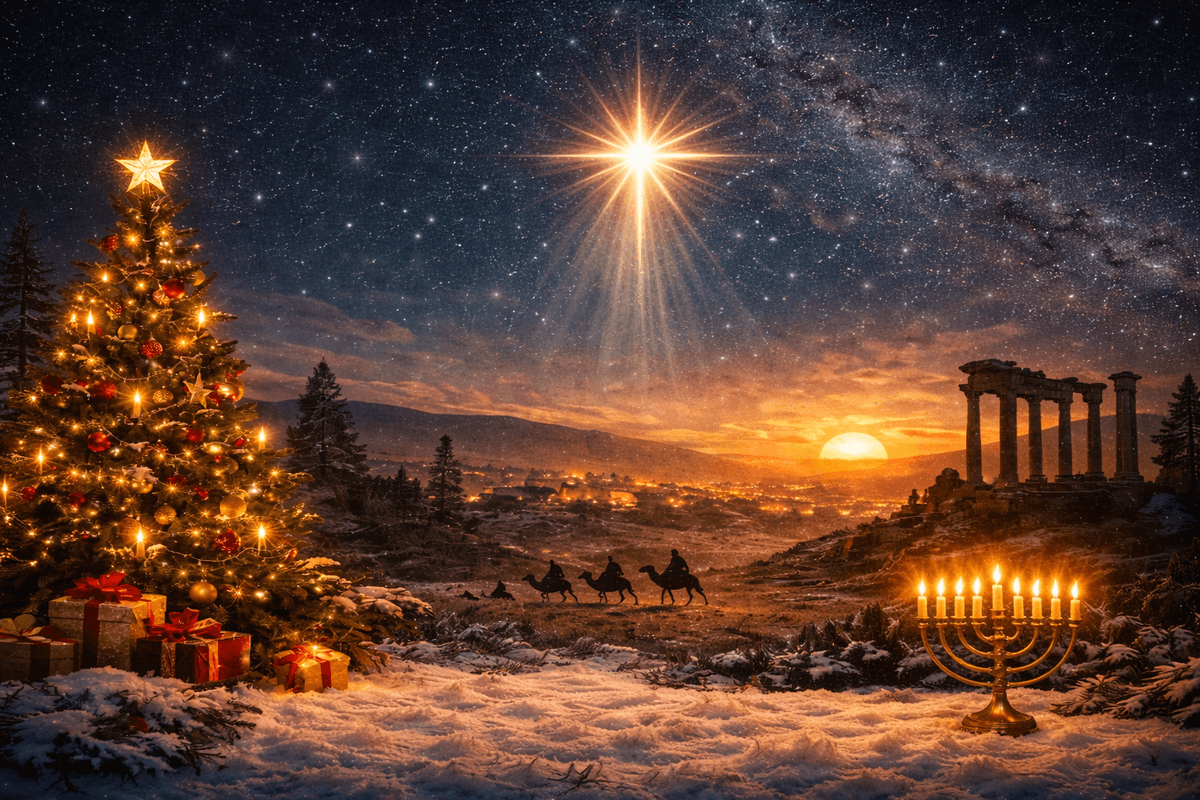
It is the story of how humans, across time and cultures, have always chosen light, hope, and connection when the world outside grows dark.
A Warm Closing — And an Invitation to Wander With Me
If these layers of history, symbolism, and winter mythology touched your curiosity, I would love to guide you deeper.
Amsterdam is full of stories like this — hidden in churches, bridges, synagogues, canals, and quiet corners shaped by centuries of human longing and imagination.
On my tours, I weave history with reflection, myth with meaning, and culture with emotion.
Whether you love spiritual symbolism, Jewish heritage, Dutch history, or simply beautiful stories, I’ll take you through the city in a way that feels intimate, warm, and unforgettable.
Come walk with me — and let Amsterdam reveal her soul to you.
With love,
Constanza